
SAUDI ARABIAENGINEERING BELOW. PROGRESS ABOVE.Built for your next project

Practical knowledge.
Stronger capability.

Capability development for operators, site teams and engineers. Let’s discuss your team’s needs, experience and next step.

TRAINING GUIDE / REVIEW FIRST

From understanding the method
to reviewing the decision.

Three levels in HDD, then microtunnelling. Learning progresses from planning and mobilisation through operation, monitoring, abnormal conditions, completion and handover.

128learning hours for both full pathwaysCORE 8 + HDD 60 + MT 60

BEFORE EITHER METHOD / CORE

Shared core: site safety & lifecycle

8 hours · once

The common foundation does not replace site induction, permits or manufacturer instructions. Every role works within project engineering and current Saudi requirements.

4 hours live · 2 hours self-study · 2 hours assessed tabletop
Shared safety controls & assessment
  • Planning and permits: verify utilities using the approved locating/exposure process; resolve uncertainty before starting. No generic clearance value replaces the project design.
  • Shafts and excavations: engineered support, water control, protected access and inspected barriers; stop for instability, flooding or compromised support.
  • Confined spaces: only an authorised permit, competent team, atmosphere controls and a workable rescue plan can permit entry. Never enter to attempt an unplanned rescue.
  • Lifting and stored energy: approved lift plans, inspected equipment, exclusion zones and isolation before intervention; never work beneath a suspended load.
  • Heat and welfare: apply current Saudi requirements and the site heat plan, with hydration, rest and emergency response. Stop and escalate suspected heat illness.
  • Environment and abnormal conditions: monitor returns, ground movement, spills and water ingress; stop, secure the area safely and notify the responsible lead. Restart only after authorised review.
  • Completion and handover: isolate safely, manage waste, reinstate the site and preserve quality, incident and as-built records.
Prerequisites & assessment

No prior experience is required; agree delivery language and technical-reading support before starting. The tabletop covers utility verification, shaft access, lifting, heat and environmental response. Any critical unsafe response requires correction and reassessment; this core grants no work, entry or rescue authorisation.

Stop when uncertain. If utilities cannot be verified or safety controls are compromised, stop work, secure the area without exposing yourself to danger and notify the responsible lead. Resume only after authorised review and approval.

FIRST PATHWAY

Horizontal directional drilling

60 method hoursBeginner → Practitioner → Expert-level

01 / BeginnerHDD-B

Understand the complete crossing

Read the job, recognise the equipment and follow the pilot–ream–pullback sequence through handover.

For whom? New operators, site teams and engineers entering HDD.

12 learning hours6 live · 4 self-study · 2 assessment
Objectives & course content
Learning objectives
  • Explain the HDD lifecycle and the responsibilities of each team member.
  • Recognise missing planning inputs and conditions requiring stop-work escalation.
  • Interpret a simple drilling record and identify completion evidence.
Topics across the lifecycle
  1. Feasibility, ground information, utility verification, permits and alignment concepts.
  2. Mobilisation, equipment roles, exclusion zones and pre-start checks.
  3. Pilot drilling, tracking and communication between operator and locator.
  4. Reaming, pipe preparation and pullback sequence awareness.
  5. Drilling-fluid returns, monitoring and abnormal-event stop-work decisions.
  6. Completion, project-specified testing, reinstatement and as-built handover.
Prerequisites & assessment
Before taking this course
  • Complete CORE before method teaching; no previous HDD experience is required.
  • Basic technical literacy and numeracy; agree language and learning support before delivery.
Proposed assessment

Knowledge check and a simple crossing-sequence exercise with answer rationale. Unsafe start-work or emergency responses require review and reassessment.
02 / PractitionerHDD-P

Plan, monitor and respond

Connect an approved plan to operational records, fluid management and controlled responses to change.

For whom? Operators, locators and site engineers building applied HDD judgement.

24 learning hours12 live · 4 self-study · 8 assessed simulation / case work
Objectives & course content
Learning objectives
  • Prepare a supervised execution plan from supplied site and ground information.
  • Interpret tracking, drilling and returns trends against project/OEM limits.
  • Document escalation, restart approval and traceable completion records.
Topics across the lifecycle
  1. Ground-model review, utility interfaces, bore-plan constraints and risk controls.
  2. Mobilisation plans, equipment/tooling checks and agreed hold points.
  3. Pilot steering and tracking records; deviation recognition and reporting.
  4. Fluid properties, circulation, reaming sequence and pullback readiness.
  5. Loss of returns, inadvertent returns, obstruction and stuck-tool scenarios.
  6. Quality records, specified acceptance tests, waste handling and handover.
Prerequisites & assessment
Before taking this course
  • CORE and HDD-B, or a documented equivalent reviewed by the proposed trainer.
  • Familiarity with site records; prior exposure is useful but does not replace site authorisation.
Proposed assessment

Eight assessed hours of simulation or case work: execution planning, log interpretation, abnormal-event decisions and a handover pack. Critical unsafe decisions must be corrected before completion is recommended.

03 / Expert-levelHDD-E

Review complex decisions

Challenge assumptions, lead change control and evaluate evidence across the full HDD lifecycle.

For whom? Experienced supervisors, engineers and technical reviewers; this is an intended audience, not accreditation.

24 learning hours12 live · 4 self-study · 8 assessed simulation / case work
Objectives & course content
Learning objectives
  • Critique feasibility and design assumptions without substituting for authorised design approval.
  • Evaluate combined operational, environmental and utility-interface risks.
  • Defend stop/restart decisions and acceptance recommendations using evidence.
Topics across the lifecycle
  1. Complex-crossing feasibility, uncertainty and alternative-method reviews.
  2. Bore geometry, installation-load and ground/fluids assumptions for engineering review.
  3. Mobilisation assurance, competence interfaces and contingency/hold-point planning.
  4. Integrated pilot, reaming and pullback trend interpretation.
  5. Abnormal-event diagnosis, environmental response and controlled design changes.
  6. Completion evidence, non-conformances, acceptance boundaries and lessons learned.
Prerequisites & assessment
Before taking this course
  • CORE and HDD-P, or documented equivalent learning reviewed by the trainer. Both routes also require documented relevant HDD experience and current role competence verified by the trainer/employer.
  • Ability to interpret plans and logs and discuss risk decisions; specialist design remains with authorised professionals.
Proposed assessment

Eight assessed hours of complex-case review, decision defence and completion-evidence audit. Assessment examines reasoning and safety escalation, not professional design licensure or field competence.

SECOND PATHWAY

Microtunnelling & pipe jacking

60 method hoursBeginner → Practitioner → Expert-level

01 / BeginnerMT-B

Understand the jacking system

Follow a remotely controlled microtunnel from investigation and shafts to drive completion and handover.

For whom? New microtunnelling team members, site staff and engineers.

12 learning hours6 live · 4 self-study · 2 assessment
Objectives & course content
Learning objectives
  • Describe the machine, jacking frame, pipe string and slurry-circuit roles.
  • Recognise shaft, lifting, stored-energy and confined-space boundaries.
  • Explain drive monitoring and the records needed at completion.
Topics across the lifecycle
  1. Method suitability, ground/water information, utilities and alignment planning.
  2. Launch/reception shafts, engineered support, access and mobilisation controls.
  3. Remote machine operation, jacking sequence and pipe-joint awareness.
  4. Slurry circulation, separation, guidance and routine monitoring.
  5. Ground loss, inflow, obstruction and emergency stop/escalation awareness.
  6. Reception, project-specified testing, shaft closure, reinstatement and handover.
Prerequisites & assessment
Before taking this course
  • Complete CORE before method teaching; no previous microtunnelling experience is required.
  • Basic technical literacy and numeracy; no shaft-entry or confined-space authority is conferred.
Proposed assessment

Knowledge check and a launch-to-reception sequence exercise with answer rationale. Unauthorised shaft entry, unsafe lifting or failure to escalate inflow are critical safety failures requiring reassessment.

02 / PractitionerMT-P

Control the drive and its interfaces

Apply approved drive plans, interpret operating trends and coordinate safe shaft and surface interfaces.

For whom? Microtunnelling operators, shaft supervisors and site engineers.

24 learning hours12 live · 4 self-study · 8 assessed simulation / case work
Objectives & course content
Learning objectives
  • Build a supervised mobilisation and drive-control plan from supplied project inputs.
  • Interpret guidance, jacking-force, slurry and ground-response trends.
  • Prepare a controlled response and traceable quality/handover records.
Topics across the lifecycle
  1. Ground-model review, shaft/utility interfaces and project engineering inputs.
  2. Jacking-frame readiness, launch seals, pipe handling and lifting plans.
  3. Face-support concepts, slurry balance, separation and lubrication.
  4. Guidance, pipe joints, jacking-force trends and approved operating limits.
  5. Inflow, obstruction, ground movement and controlled intervention decisions.
  6. Reception readiness, survey/quality evidence, acceptance and reinstatement.
Prerequisites & assessment
Before taking this course
  • CORE and MT-B, or a documented equivalent reviewed by the proposed trainer. Relevant microtunnelling/site experience must also be accepted by the trainer, regardless of the learning route.
  • Familiarity with site plans and logs; shaft, lifting and confined-space roles require separate authorisation.
Proposed assessment

Eight assessed hours of drive-planning, trend-analysis and abnormal-event simulation/case work, ending with a quality and handover pack. Critical unsafe responses require correction and reassessment.

03 / Expert-levelMT-E

Review complex drives and assurance

Evaluate ground uncertainty, shaft/drive interfaces, interventions and acceptance evidence across the lifecycle.

For whom? Experienced supervisors, engineers and technical reviewers; expert-level describes the audience only.

24 learning hours12 live · 4 self-study · 8 assessed simulation / case work
Objectives & course content
Learning objectives
  • Critique method, shaft and drive assumptions within defined engineering responsibilities.
  • Evaluate combined face-support, jacking, ground-movement and intervention risks.
  • Defend change-control, stop/restart and completion recommendations with evidence.
Topics across the lifecycle
  1. Complex-drive feasibility, ground/water uncertainty and alternative methods.
  2. Shaft design interfaces, launch/reception assurance and competence boundaries.
  3. Face-support and slurry-system assumptions; limits remain project/OEM-specific.
  4. Jacking loads, lubrication, intermediate-station concepts and monitoring evidence.
  5. Ground movement, difficult interventions and engineered change/recovery reviews.
  6. Completion audits, non-conformances, acceptance boundaries and lessons learned.
Prerequisites & assessment
Before taking this course
  • CORE and MT-P, or documented equivalent learning reviewed by the trainer. Both routes also require documented relevant microtunnelling experience and current role competence verified by the trainer/employer.
  • Ability to interpret drive records and engineering interfaces; specialist interventions need separate approved competence.
Proposed assessment

Eight assessed hours of complex-drive review, intervention decision defence and a completion audit. No compressed-air, rescue, shaft-entry, engineering licence or field-operation qualification is awarded.

ONLINE OR SEMINAR DELIVERY

A relative schedule. Nothing booked.

Proposed for review only: dates, trainer, fees and venue are TBD and unbooked. Weeks are relative to a start agreed later; this page creates no calendar events or enrolments.

Two delivery options for the same programme — not cumulative hours
ModuleOnline weeksLearning hoursProposed seminar days
COREShared core — taken onceWeek 08 hours / week8 hours1 × 8 hours
HDD-BBeginnerWeek 1–26 hours / week12 hours2 × 6 hours
HDD-PPractitionerWeek 3–66 hours / week24 hours4 × 6 hours
HDD-EExpert-levelWeek 7–106 hours / week24 hours4 × 6 hours
MT-BBeginnerWeek 11–126 hours / week12 hours2 × 6 hours
MT-PPractitionerWeek 13–166 hours / week24 hours4 × 6 hours
MT-EExpert-levelWeek 17–206 hours / week24 hours4 × 6 hours
Both full pathwaysPreparatory week + 20 weeks128 hours21 days total

Online Week 0: CORE, eight hours. Method teaching is six learning hours per week, including live, self-study and assessment. Beginner: 3 live + 2 self-study + 1 assessment weekly; practitioner/expert: 3 live + 1 self-study + 2 assessed simulation or case hours weekly.

Seminars One shared 8-hour day, then per method: beginner 2 × 6-hour days, practitioner 4 × 6, expert 4 × 6. Reading, exercises and assessment are incorporated into the proposed days; the detailed session pattern and breaks are agreed later. Field competence remains separate.

TEXTBOOKS / ILLUSTRATIONS / VIDEO

A review library, not a student release.

English teaching drafts cover objectives, explanations, exercises, assessment and answer rationale, critical safety failures, references, illustration briefs and video storyboards. Technical, safety and Arabic-language review plus owner approval are required before student use.

Review drafts prepared for owner review — learner release withheld

PROGRAMME

Programme guide & proposed schedule

Pathways, hours, assessment and approval gates

Review draft v0.1Prepared for owner review
RESOURCE-REGISTER

Resource & reference register

Sources, access status and use boundaries

Review draft v0.1Prepared for owner review
REVIEW-AND-RELEASE

Review & student-release guide

Competent sign-off and separate learner/assessor editions

Review draft v0.1Prepared for owner review
CORE

Shared core: site safety & lifecycle

Common to both pathways; taken once

Review draft v0.1Prepared for owner review
HDD-B

Horizontal directional drilling — Beginner

Understand the complete crossing

Review draft v0.1Prepared for owner review
HDD-P

Horizontal directional drilling — Practitioner

Plan, monitor and respond

Review draft v0.1Prepared for owner review
HDD-E

Horizontal directional drilling — Expert-level

Review complex decisions

Review draft v0.1Prepared for owner review
MT-B

Microtunnelling & pipe jacking — Beginner

Understand the jacking system

Review draft v0.1Prepared for owner review
MT-P

Microtunnelling & pipe jacking — Practitioner

Control the drive and its interfaces

Review draft v0.1Prepared for owner review
MT-E

Microtunnelling & pipe jacking — Expert-level

Review complex drives and assurance

Review draft v0.1Prepared for owner review

Process illustrations & video prototypes

Two English-narrated review prototypes are available with captions and transcripts: HDD pilot/ream/pullback (48.7 seconds) and slurry microtunnelling/pipe jacking (54.3 seconds). The full video library remains approval-gated; lesson storyboards are not rendered videos.

Horizontal directional drilling

Review draft v0.1
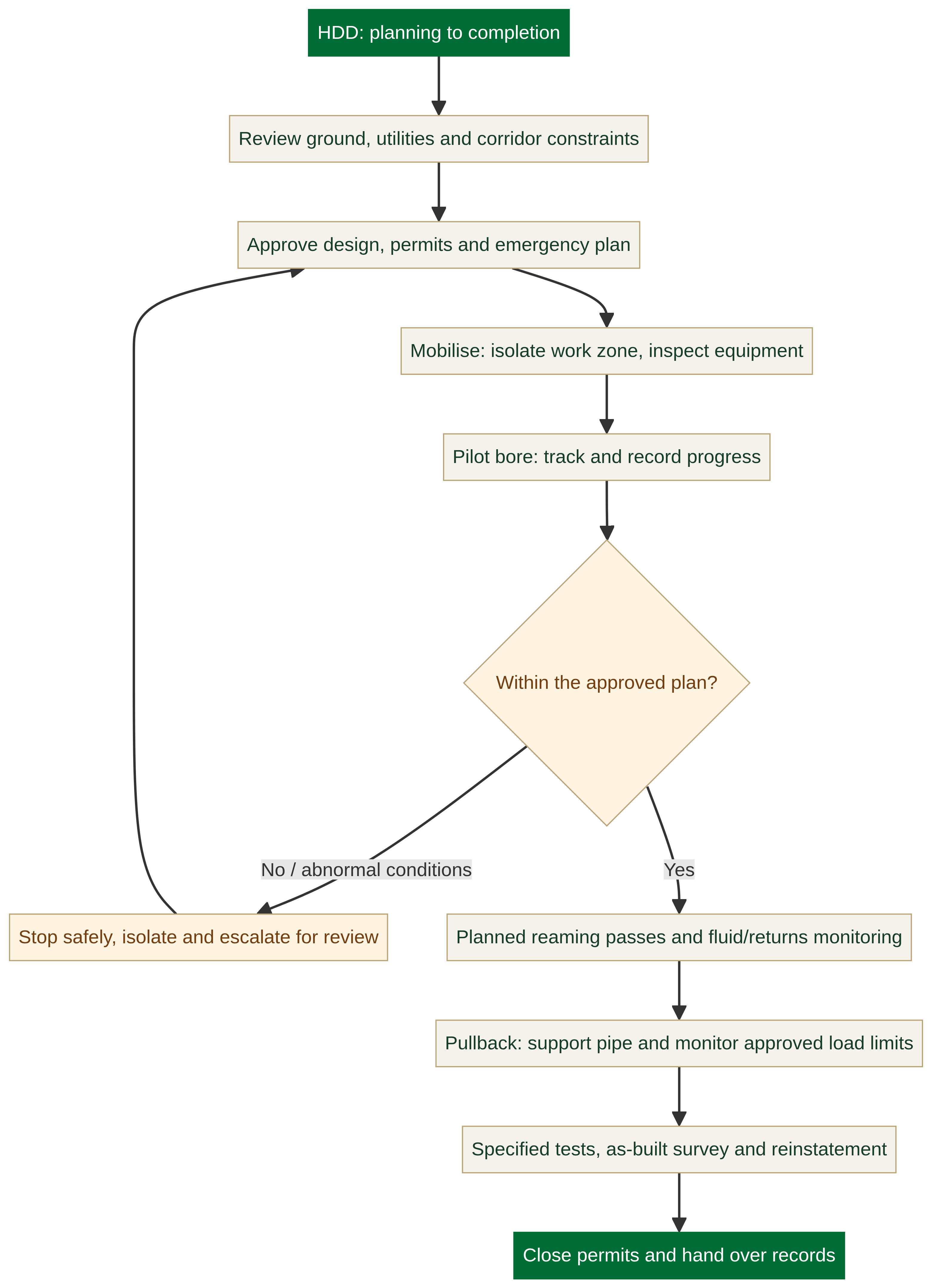
Process diagram of pilot drilling, reaming and pipe pullback between entry and exit, with guidance and fluid-return monitoring. Conceptual and not to scale.
Process illustration for review · conceptual, not to scale
3D process-review prototype

English technical-review material; not operating instructions, alignment geometry, clearance values or operating limits. Arabic technical review is required before learner release.

Microtunnelling & pipe jacking

Review draft v0.1
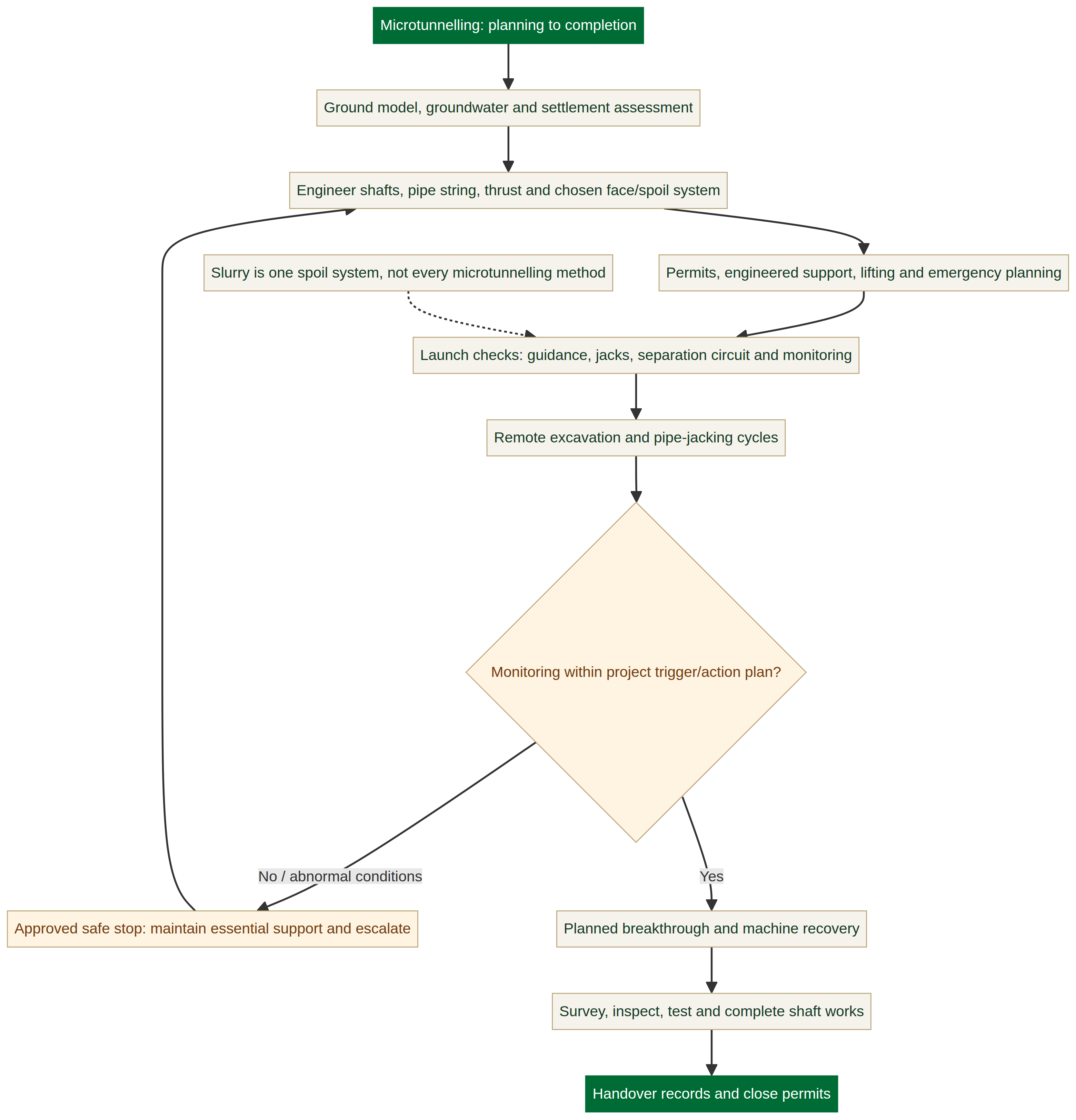
Process diagram of a remotely controlled microtunnelling machine between launch and reception shafts, with a jacking frame, pipe string, slurry circuit and surface separation. Conceptual and not to scale.
Process illustration for review · conceptual, not to scale
3D process-review prototype

English technical-review material; not operating instructions, alignment geometry, clearance values or operating limits. Arabic technical review is required before learner release.

References & use boundaries

Foreign HSE and OSHA guidance is educational reference, not Saudi law. Official Saudi pages provide limited local context, not a substitute for current requirements or actual project permits. OEM limits and project engineering still govern. Source access is not approval of these drafts or permission to reproduce third-party content.

AFTER PATHWAY REVIEW

Later methods. Controlled learner release.

Proposed roadmap topics, not bookable courses. Development follows review of the HDD and microtunnelling pathways.

  • Auger boring
  • Pipe ramming
  • Pipe bursting
  • Trenchless rehabilitation

Learner-release gates

  1. Technical, safety, source and rights review
  2. Arabic technical review and owner version approval
  3. Assessment, trainer and competence-boundary approval
  4. Authenticated learner access, approved versions and instructor assessment

The student portal supports enrolment requests, recorded online participation hours and completion certificates after approved admission, hours and authorised assessment. An enquiry does not book a date, and attendance alone does not earn a certificate.

Student portal & certificates

Training completion ≠ independent accreditation.

Support may include training-completion documentation, requirements reviews and guidance on qualification pathways. This website does not claim that RABCO is an accredited awarding body or is authorised to issue independent professional qualifications.

Any awarding body, standard, assessment and accreditation scope must be confirmed in writing before enrolment. Participation alone does not guarantee certification.

What does your
team need next?

Share team size, experience, topics and preferred timing. Your details will be used to respond to your enquiry.

Contact RABCO+966570303031Rruziek@outlook.com

Operators, site teams and engineers. We discuss experience levels and team size to shape an appropriate scope.

Training enquiry

* Required fields. An enquiry is not a booking or an accepted quotation.